Best AI App Builder for Internal Tools (2026): Where an AI Builder Wins and Where It Doesn't
For internal tools, the honest answer is often not an AI app builder. Here is the axis that decides it: does the tool connect to your existing production data, or does it start greenfield? A 2026 comparator across five AI builders, plus when to buy a purpose-built platform instead.
Updated on July 25, 2026
On this page
Quick answer (2026)
For most internal tools, the best tool is not an AI app builder at all. If the tool reads and writes your existing production database and needs role-based access plus an audit trail, a purpose-built internal-tool platform (Retool, Appsmith, Budibase) is the honest pick, because it connects straight to your data. AI app builders like Replit, Base44, Bolt.new, v0, and Lovable earn their place in a narrower case: when you want a standalone, owned app you will keep and extend, not an admin panel bolted onto prod data. Choose by whether the tool touches existing data or starts greenfield, not by which demo renders fastest.
The question is usually mis-framed
Type "best AI app builder for internal tools" into Google in 2026 and you get two piles of results that quietly disagree with each other. One pile lists AI app builders (Replit, Lovable, v0, Base44). The other lists purpose-built internal-tool platforms (Retool, Appsmith, ToolJet, Budibase, WeWeb). The round-ups rarely say which pile you actually belong in.
Here is the distinction that decides it. An internal tool is, most of the time, a thin interface over data you already have: an ops dashboard, an admin panel, a refund console, a support lookup, a fulfillment queue. The hard part is not generating screens. The hard part is connecting safely to your production database, gating who can touch which rows, and leaving an audit trail when they do.
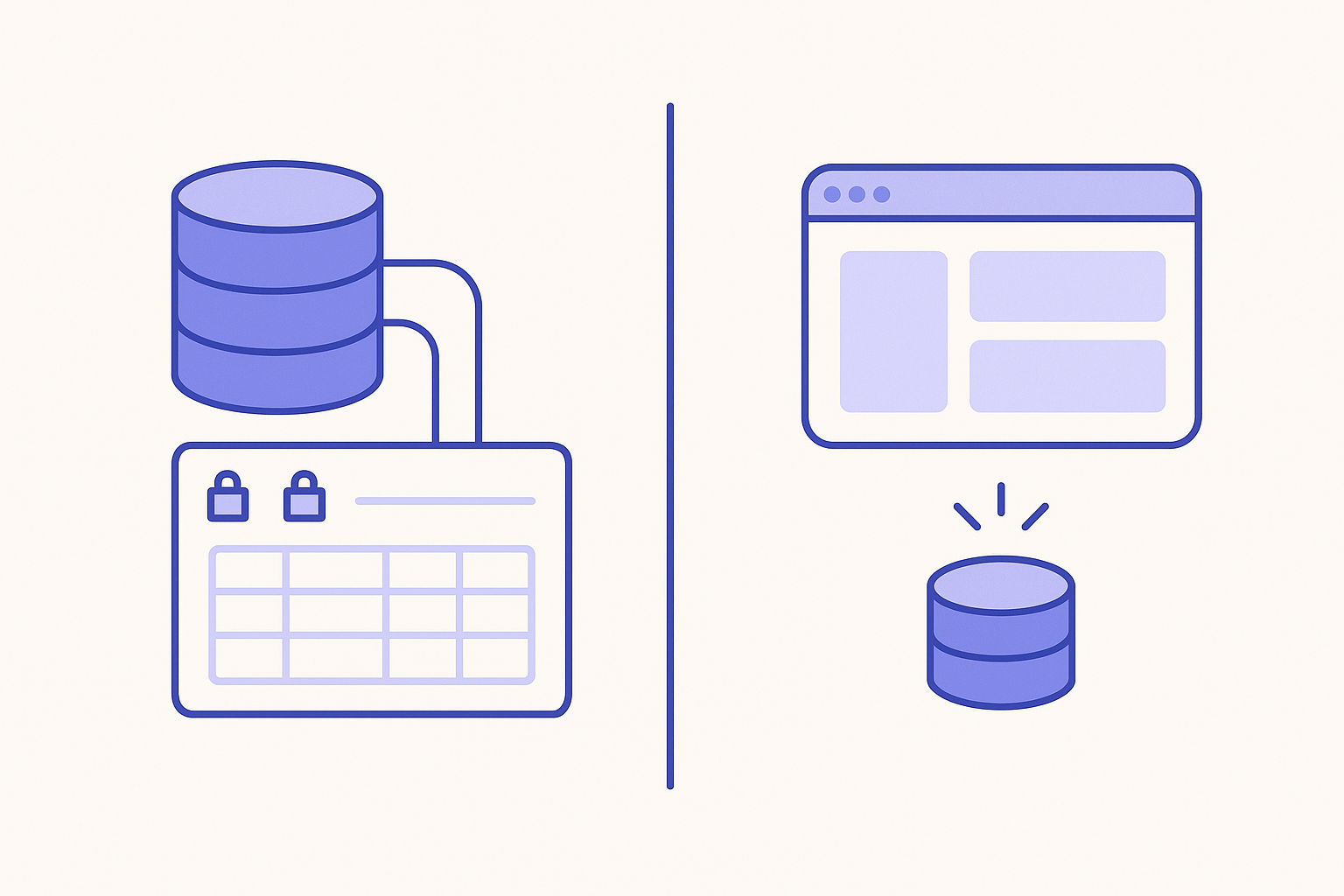
An AI app builder is optimized for the opposite job. It generates a brand-new, standalone application with its own fresh database. That is a greenfield problem, not a connect-to-existing-data problem. When you point a greenfield generator at an internal-tool job, you spend your time bridging it back to the data and permissions it was never designed around.
So the real axis is not build speed. It is this: does the tool sit on top of your existing production data, or is it a new app you will own and run?
The axis that actually decides it
Score any candidate on the criteria that matter for internal software, not for a launch demo:
- Connects to your existing production DB. Can it read and write your real Postgres, MySQL, Mongo, or REST API directly, safely, and without exporting the data into a second store?
- Roles and permissions. Can you gate actions by team and role without hand-rolling an auth system?
- Self-host and audit. Can you run it inside your own perimeter and keep a record of who changed what?
- Code ownership. If you outgrow it, do you leave with real, portable source, or a proprietary shell?
- Best-fit job. What internal-tool shape is this actually good at?
On the first three criteria, purpose-built platforms win by design. The interesting question is where the AI app builders land, because sometimes an internal tool really is a small standalone product, and then a builder is the right call.
Comparator: five AI app builders on the internal-tool job (2026)
We scored the five AI app builders that show up most in this SERP against the internal-tool criteria above. No crown: the right pick depends on your job, and for classic admin-over-prod-data tools the honest answer is a purpose-built platform (next section).
Scroll to see more
| Builder | Connects to existing prod DB | Roles / permissions | Self-host / audit | Code ownership | Best-fit internal-tool job |
|---|---|---|---|---|---|
 Replit Replit | Partial (external DB possible, manual) | App-level, hand-built | Cloud-hosted; full source export | Strong: full source + IDE + built-in tests | A standalone internal app you will keep and extend |
 Base44 Base44 | Prefers own DB | App-level | Cloud; GitHub source export (2026) | Good: GitHub export, no npm import | Fast first-draft internal app with its own data |
 Bolt.new Bolt.new | Prefers own DB | App-level | Cloud | Full source, but watch token-burn cost | Quick internal prototype you will iterate on carefully |
 v0 v0 | Prefers own DB | App-level | Cloud (Vercel) | Source in the Vercel ecosystem | UI-forward internal dashboard, simple data only |
 Lovable Lovable | Supabase-backed | Via Supabase | Cloud | Full source, stability caveats | A simple standalone web tool, not data-heavy ops |
Every builder here spins up its own application and, by default, its own database. None of them is built to be an admin panel over your existing prod data with row-level roles and an audit log. That is not a knock; it is a category boundary.
Honest per-builder notes
When to buy a purpose-built platform instead
If your internal tool is a layer over existing production data (and most are), the honest recommendation is a platform built for exactly that:
- Retool is the established standard. It connects directly to Postgres, MySQL, Mongo, and REST APIs, and ships roles, permissions, and audit as first-class features. For a data-connected admin panel, this is the shape you are actually looking for.
- Appsmith is the open-source option you can self-host inside your own perimeter, with the same connect-to-existing-DB model and no per-seat cloud bill.
- Budibase is another open-source, self-hostable platform aimed at internal tools and back-office apps, strong when data residency and cost control matter.
ToolJet and WeWeb sit in the same category if you want to widen the shortlist. The common thread: these tools start from your data and add a UI, which is the reverse of what an AI app builder does.
A decision rule you can hand your team
- Does the tool read and write your existing production database? If yes, and it needs roles plus an audit trail, buy a purpose-built platform (Retool for cloud, Appsmith or Budibase for self-host). Stop here; this is most internal tools.
- Is the tool really a small standalone product you will own, extend, and host, with its own data model? Then an AI app builder earns its place. Pick Replit if survivability and testing matter most, Base44 if speed matters most.
- Is it a throwaway you will use twice? Any builder is fine; optimize for whichever gets you there fastest, and do not wire it to prod.
The mistake is picking by demo speed. The screen renders fast in every tool. What decides the next two years is whether the thing safely touches your data and who is allowed to press the buttons.
For the full side-by-side of these builders across every criterion, see our [[ai-app-builder-comparison-matrix-2026]]. For a related buy-versus-build call in a different context, our take on the best-ai-app-builder-for-nonprofits walks through the same system-of-record trap.
Sources
- Retool platform overview and data-source connectors, retool.com (2026).
- Appsmith and Budibase open-source self-hosting documentation, appsmith.com and budibase.com (2026).
- Public 2026 AI app builder comparator covering stability, source export, and data-model handling across Replit, Base44, Bolt.new, v0, and Lovable.
- Live SERP analysis for "best ai app builder for internal tools", July 2026.
Written by
Builderdex EditorialBuilderdex compares AI app builders on the criteria that actually decide a build, one use-case at a time.
Frequently asked questions
What is the best AI app builder for internal tools in 2026?
There is no single winner, because most internal tools are not a good job for an AI app builder at all. If the tool reads and writes your existing production database and needs role-based access, a purpose-built internal-tool platform such as Retool, Appsmith, or Budibase is usually the better pick. Among AI app builders, Replit is the most defensible choice when you genuinely want a standalone, owned app, because it ships full source, a real IDE, and built-in testing.
Should I use an AI app builder or a platform like Retool for an internal admin panel?
Use a Retool-style platform when the admin panel is a thin layer over your existing production data: it connects directly to Postgres, MySQL, Mongo, or a REST API and gives you roles and audit out of the box. Reach for an AI app builder only when the internal tool is really a small standalone product you will keep, extend, and host yourself, with its own data model rather than a view onto prod.
Can AI app builders connect to my existing production database?
Most of them prefer to create their own database rather than attach to your existing one. Several can talk to an external Postgres, but that path is rougher than a purpose-built internal-tool platform, and you take on connection security, read-replica safety, and permissions yourself. If connecting to existing prod data is the whole point of the tool, that is a strong signal to buy rather than generate.
What is the cheapest way to build a simple internal tool in 2026?
For a genuinely simple internal tool over existing data, the open-source, self-hostable platforms (Appsmith, Budibase, ToolJet) are the cheapest durable option because you can run them on your own server with no per-seat cloud bill. Among AI app builders, watch for token-burn pricing on iterative builds; a tool you edit weekly can cost more to maintain on a usage-metered builder than a flat self-hosted platform.
Which AI app builder should I avoid for data-heavy internal tools?
Be cautious with builders that have documented instability on complex data models. In a public 2026 comparator, v0 showed SQL and crash issues on data-heavy specs, and Lovable was flagged as less stable for anything beyond a simple web tool. For an internal tool that mutates real records, prioritize stability, roles, and testing over how fast the first screen appears.
Related comparisons
Best AI App Builder for Nonprofits (2026)
For most nonprofits an AI app builder is the wrong tool for the donor job. We score five builders on the one layer they actually fit in 2026.
Best AI App Builder for E-commerce (2026): Storefront vs Ops App
There is no single best AI app builder for e-commerce, because the phrase hides two jobs. Use Shopify or Medusa for the storefront; use Replit, Bolt.new, Lovable, v0, or Base44 for the custom ops app. A 2026 comparator scored on the axes that matter.
Best AI App Builder for Field Service Teams (2026)
For the offline technician app an AI app builder is the wrong category; for the back-office layer around your FSM system it shines. An integration-first comparison of five builders for 2026.