Best Open-Source AI App Builder to Self-Host (2026)
A self-host-first comparison of the best open-source AI app builders in 2026: Appsmith, Budibase, ToolJet, NocoBase and Reflex, scored on license, deployment and where the AI features actually live.
Updated on August 27, 2026

On this page
Quick answer
If self-hosting and a genuine open-source license are hard requirements, the best open-source AI app builder in 2026 is Appsmith for teams that want a mature Apache-2.0 platform with the widest deployment options, and Budibase for teams that want the fastest path from a database to a working internal app. ToolJet has the most ambitious AI feature set, but it gates AI app generation behind its paid enterprise edition. NocoBase wins for data-model-first business systems, and Reflex wins when your team writes Python and wants to own the entire stack as code. None of the well-known cloud AI builders belong on this list, because they are closed-source hosted services you cannot run on your own infrastructure. All license and feature claims below were checked against each project's GitHub repository on July 1, 2026.
Why the famous AI builders are not on this list
Most "best AI app builder" roundups lead with the cloud tools: you type a prompt, a hosted service builds and runs the result. Those tools are useful. They are also the wrong answer to a specific question, which is the one this article asks: what can I run on hardware I control, under a license I can read?
There is also a second group worth its own comparison: the open-source, chat-based Lovable clones you self-host, such as Dyad and Open Lovable. If that is closer to what you want, see our companion guide to the open-source Lovable alternative options. This article stays on the low-code platforms you install and own.


So this list has one entry rule: the core must be published under a license recognized by the Open Source Initiative and ship a documented self-host path. That rule alone removes most of the tools you have seen ranked elsewhere.
How we scored (the axis nobody else uses)
The generic roundups score AI builders on output quality and speed. For a self-host buyer, that is the wrong axis. Builderdex scored these five on the criteria that actually decide the purchase:
- License class. Is the core under an OSI-approved license (Apache, GPL, AGPL, MPL), or is it "source-available" with strings attached?
- Self-host maturity. Docker one-liner, Kubernetes manifests, cloud deployment guides, or a README that assumes you will figure it out.
- AI-generation depth, and where it lives. This is the trap the other lists miss: several of these keep their best AI features behind a commercial license, so the open-source edition you self-host does not include them.
- Data model and database support. Bring-your-own Postgres, built-in tables, external connectors.
- Extensibility and code ownership. Custom code, plugins, and whether you can fork it.
The 2026 open-source AI app builder comparison
Scroll to see more
| Tool | Core license | Self-host | AI generation | AI in the OSS edition? | Best for |
|---|---|---|---|---|---|
 Appsmith Appsmith | Apache-2.0 | Docker, K8s, AWS AMI | Appsmith Agents + Copilot | Partial | Widest deploy options |
 Budibase Budibase | GPL v3 (core) | Docker, K8s, DigitalOcean | AI agents + automations | Partial | Fastest DB-to-app |
 ToolJet ToolJet | AGPL v3 | Docker, K8s, AWS, Azure, GCP | AI app gen + Agent Builder | No (enterprise) | Broadest cloud guides |
 NocoBase NocoBase | Apache-2.0 | Docker, self-host | AI + no-code, agent-friendly | Partial | Data-model-first systems |
 Reflex Reflex | Apache-2.0 | Your own host, any Python env | AI Builder (hosted) | Framework yes, AI hosted | Python teams owning the stack |
Appsmith: the safest Apache-2.0 default
Honest trade-off: Appsmith is a UI-builder-over-your-data tool, not a "describe an app and get a full codebase" generator. If you want a drag-and-connect internal tool with an AI assistant, it is the strongest default. If you want end-to-end prompt-to-app generation, ToolJet and Reflex aim closer at that, with the caveats below.
Budibase: fastest path from a database to a usable app
Honest trade-off: the mixed license matters. The GPL v3 core is genuinely open, but read the Business Source License terms before you assume every feature you see in the marketing is in the self-hosted community build.
ToolJet: the most AI-ambitious, and the biggest license asterisk
Honest trade-off, and it is the one every other list ignores: those AI features are part of ToolJet's enterprise edition, not the community build. The community edition is a strong AGPL visual builder with integrations. If your whole reason for self-hosting an open-source tool is to get AI generation for free, ToolJet does not give you that in the open edition. Verify the current edition split before you commit.
NocoBase: data-model-first, agent-friendly
Honest trade-off: the model-first approach is a strength for durable internal systems and a friction point for someone who wants to prompt a throwaway app in five minutes. Pick it when the data model is the point, not when speed-to-demo is.
Reflex: for teams who want the whole stack as Python
Honest trade-off: the framework is fully open and self-hostable; the AI generation runs as a hosted service. So the "self-host everything" story applies to your app, not necessarily to the prompt-to-app step. For Python-first teams that value owning the codebase, that is usually an acceptable split.
Which one should you pick?
- You want the safest, most portable Apache-2.0 default: Appsmith. Widest deploy options, mature, permissive license.
- You want to turn a database into an internal app the fastest: Budibase. Read the BSL terms on paid features first.
- You want the deepest AI generation and can pay for enterprise: ToolJet. The community edition alone will not give you the AI app generation.
- You are building a durable, data-model-first business system: NocoBase.
- Your team lives in Python and wants to own the codebase: Reflex.
And if none of that matters more than raw output quality and you are fine with a hosted, closed platform, then an open-source self-host tool is genuinely the wrong choice, and the cloud builders excluded at the top of this article are worth your time instead. The right tool is the one that matches your actual constraint, not the one that ranks first on a generic list. For a self-host buyer, that constraint is usually the license and the deployment path, which is exactly what we scored here. If your target is an internal tool specifically, our comparison of AI app builders for internal tools covers the hosted options too, and the full scoring rubric lives on our methodology page.
Sources
- Appsmith GitHub repository, license and deployment docs (checked July 1, 2026): https://github.com/appsmithorg/appsmith
- Budibase GitHub repository, license breakdown (checked July 1, 2026): https://github.com/Budibase/budibase
- ToolJet GitHub repository, AGPL v3 and enterprise AI features (checked July 1, 2026): https://github.com/ToolJet/ToolJet
- NocoBase GitHub repository, Apache-2.0 and AI + no-code positioning (checked July 1, 2026): https://github.com/nocobase/nocobase
- Reflex GitHub repository, Apache-2.0 and AI Builder (checked July 1, 2026): https://github.com/reflex-dev/reflex
- Open Source Initiative approved licenses list: https://opensource.org/licenses
- r/selfhosted discussion, "best self-hosted no-code app builder" (2026): https://www.reddit.com/r/selfhosted/comments/1ougt36/whats_the_best_selfhosted_nocode_app_builder_out/

Written by
Builderdex EditorialThe Builderdex editorial desk builds side-by-side scorecards of AI app builders, one use case at a time.
Frequently asked questions
What is the best open-source AI app builder in 2026?
For teams that need a real open-source license and self-hosting, Appsmith (Apache-2.0) is the safest, most portable default, and Budibase is fastest for turning a database into an internal app. ToolJet has the deepest AI features but gates AI app generation behind its paid enterprise edition.
Can Lovable, Bolt.new or v0 be self-hosted?
No. Lovable, Bolt.new and v0 by Vercel are proprietary hosted services. Some let you export generated code, but the builder itself is not open-source and cannot be run on your own infrastructure or inside an air-gapped network.
Which open-source AI app builder has the most permissive license?
Appsmith, NocoBase and Reflex are all under Apache-2.0, the most permissive of the group. Budibase's core is GPL v3 with some paid features under the Business Source License, and ToolJet is under AGPL v3.
Is ToolJet's AI app generation free in the open-source edition?
No. As of July 2026, ToolJet's AI App Generation, AI Query Builder and Agent Builder are part of its enterprise edition. The AGPL v3 community edition is a visual builder with integrations but does not include those AI generation features.
Which open-source builder is best for a Python team?
Reflex. It is Apache-2.0 and lets you build full-stack web apps in pure Python, so your team owns the entire codebase. Its AI Builder that generates apps runs as a hosted service, but the generated app self-hosts anywhere Python runs.
Why self-host an AI app builder at all?
Self-hosting matters when you need data residency, air-gapped deployment, license auditability, or full control over upgrades and integrations. If none of those apply and you only care about output quality, a hosted closed-source builder is usually the simpler choice.
Related comparisons
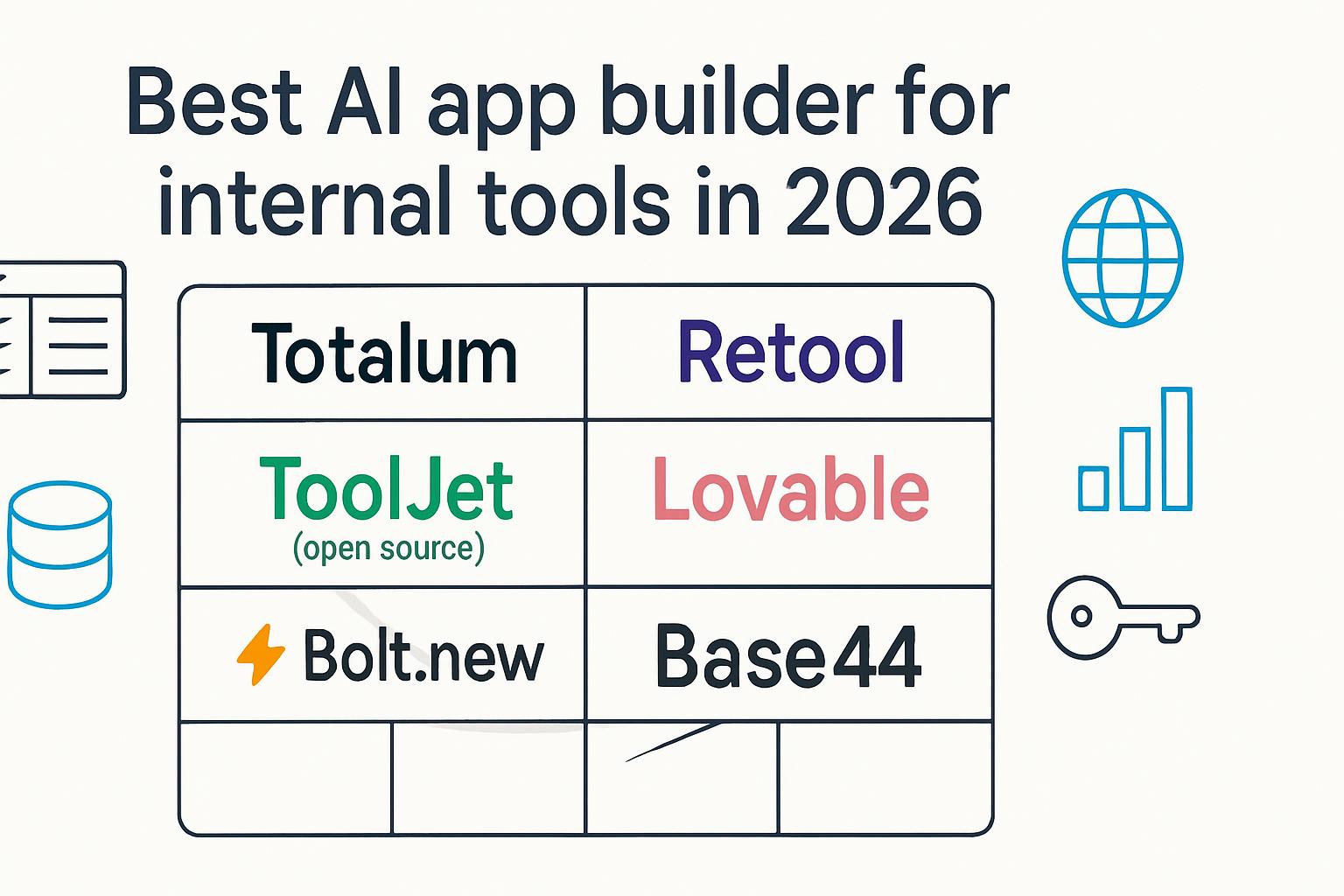
Best AI app builder for internal tools in 2026
A 6-builder scorecard for internal tools in June 2026: Totalum, Retool, Tooljet, Lovable, Bolt.new, and Base44 ranked against bundled auth, SQL connectors, RBAC, custom domains, code ownership, and per-team cost.
Best AI App Builder for Offline-First Mobile Apps (2026)
For offline-first mobile in 2026, FlutterFlow ranks first for production Flutter with Firestore or Hive, Expo plus Cursor wins for React Native with WatermelonDB or RxDB conflict-resolved sync, Thunkable is the strongest visual cross-platform builder, and Glide plus Adalo cover read-heavy use cases. The web-first AI app builders (Lovable, Bolt, v0, Totalum) should be skipped here. They produce browser apps that cannot reliably persist user mutations through twenty minutes of no signal.

Best AI app builder to white-label and resell in 2026
Five open-source AI app builders scored on the three things that decide whether you can actually resell one: licence, whether the builder UI itself is open, and who runs the infrastructure the generated apps need.