Lovable vs Bolt (2026): A Scored, Honest Comparison
In 2026, neither Lovable nor Bolt is universally better. Lovable wins on polished UI, a plan-first workflow, and beginner-friendliness; Bolt wins on raw dev control, iteration speed, and native mobile via Expo. Both export code, both are credit or token metered, and both start at $25/mo for Pro. Match the tool to the row that matters for your build.
On this page
Ask a room of builders whether Lovable or Bolt is better and you will get two confident, opposite answers. Both turn a prompt into a working app in minutes, both meter usage, and both start at $25 a month for their first paid tier. Yet they are built on different bets about how much control you want. This is a neutral, scored head-to-head, checked against each vendor's live pages in 2026, so you can pick by the criteria that actually matter to your build rather than by whoever posted loudest last week.


The one distinction that drives everything
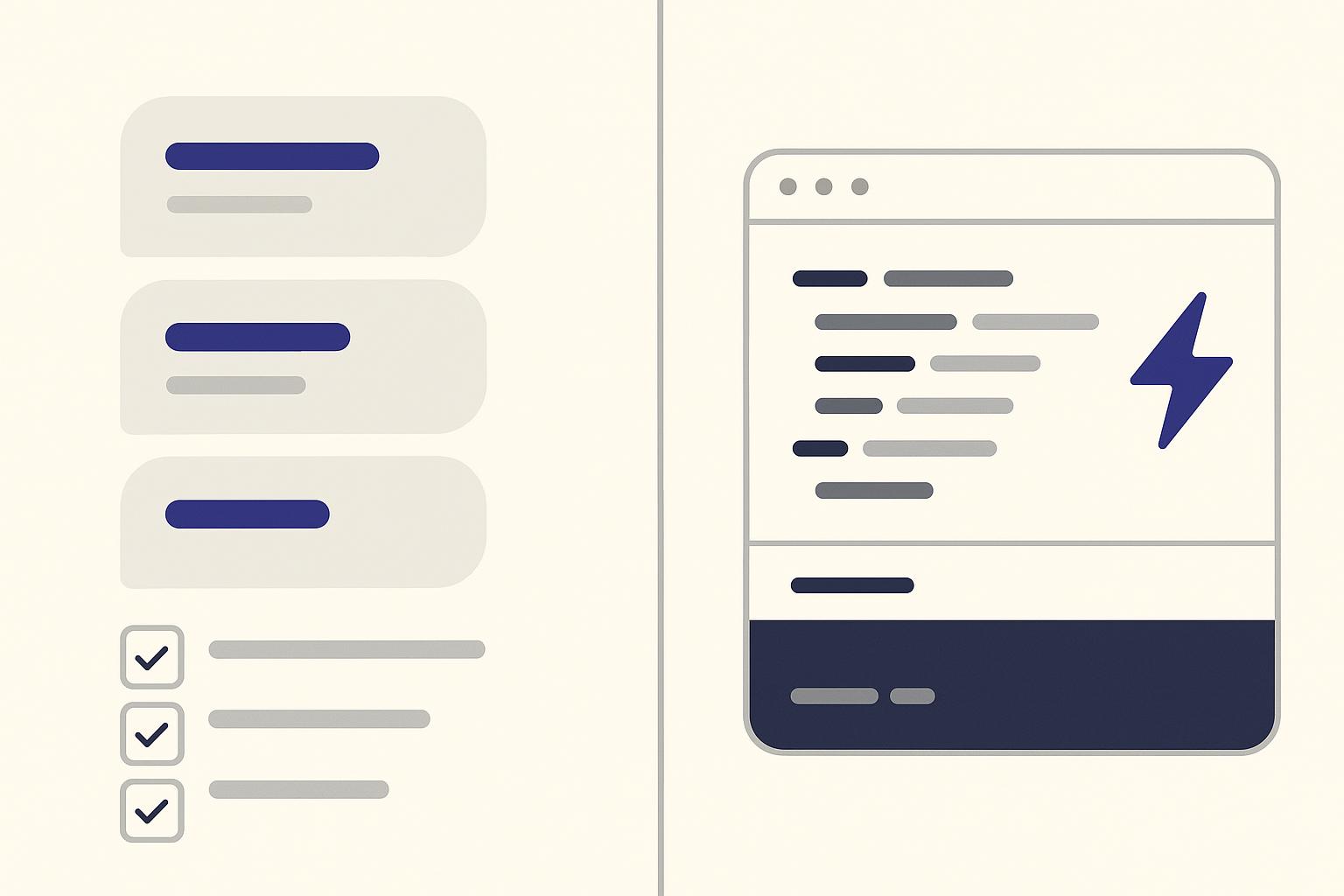
Lovable is a plan-first generator. It leans on a structured chat and a planning step, keeps you inside guardrails, and produces a clean React front end wired to a database. Its whole design optimizes for someone who wants a good result without touching a terminal.
Bolt is a browser IDE with an agent bolted on. It runs a full development environment in your browser through StackBlitz WebContainers, gives you direct access to the file tree and terminal, and assumes you are comfortable steering code. It optimizes for speed and control.
Once you internalize that split, generator-with-guardrails versus environment-with-control, every difference in UI, back end, mobile support, and pricing falls out of it.
Lovable vs Bolt at a glance (2026)
Scroll to see more
| Lovable | Bolt | |
|---|---|---|
| Core model | Plan-first app generator | Browser IDE + AI agent |
| Front end | Polished React UIs | Solid React UIs, more raw |
| Back end | Native Supabase (Postgres) | Unlimited databases, choose your provider |
| Code ownership | "You own your code", GitHub sync, export | Download + GitHub, runs on WebContainers |
| Native mobile | Web only | Yes, via Expo |
| Metering | Message / build credits | Tokens |
| Free tier | 5 build credits/day (up to 30/mo) | 1M tokens/mo (300K daily) |
| First paid tier | Pro $25/mo | Pro $25/mo |
The scorecard: seven criteria, 1 to 5
We score each tool on seven axes. A comparator that names a rubric but hides its numbers is not credible, so here are the numbers. Neither tool wins every row.
Scroll to see more
| Criterion | Lovable | Bolt |
|---|---|---|
| UI / design output | 5 | 4 |
| Back-end depth (database, auth) | 4 | 4 |
| Code ownership / export | 5 | 4 |
| Native mobile | 2 | 5 |
| Pricing predictability | 3 | 4 |
| Beginner learning curve | 5 | 3 |
| Iteration speed / dev control | 4 | 5 |
| Average | 4.0 | 4.1 |
The averages sit within a tenth of a point of each other, which is the honest headline: on the raw axes these two are close, and the tie breaks entirely on what you are building. Lovable takes the design, ownership, and beginner rows. Bolt takes mobile, pricing predictability, and control. The back end is a wash.
Where Lovable wins
Where Bolt wins
Native mobile: the clearest split

Pricing in 2026, side by side
Both are metered, which is the real cost story, not the sticker price. Figures below were read from each vendor's live pricing page in July 2026.
Scroll to see more
| Plan | Lovable | Bolt |
|---|---|---|
| Free | 5 build credits/day, up to 30/mo, plus 20 cloud credits | 1M tokens/mo, 300K daily cap, hosting, databases, Bolt branding |
| First paid | Pro $25/mo: custom domains, unlimited projects, larger credit pool | Pro $25/mo: ~10M tokens (rollover), no branding, custom domains, choose DB provider |
| Higher tier | Business $50/mo | Teams $30/mo per member |
| Metering unit | Message / build credits (monthly credits expire after ~2 months) | Tokens (roll over on Pro) |
The predictability difference is subtle but real. Lovable's credit pool is easy to reason about but the credits expire, and complex prompts can burn them faster than expected. Bolt's token model rolls over on Pro, which rewards uneven usage, but a heavy generation session can still drain a month's allotment quickly. Neither is truly flat-rate, so budget by expected volume, not by the headline $25.
What real users say

When each is the wrong pick
Lovable is the wrong pick if you need native mobile, if you want to live in the code and drive the agent from a terminal, or if expiring credits do not fit your usage rhythm.
Bolt is the wrong pick if you are non-technical and want maximum guardrails, if you want the most polished UI with the least effort, or if you would rather not think about a browser-based dev environment at all.
And both are the wrong pick when the job is not a greenfield web or Expo app at all: a content-heavy marketing site, a data-portable enterprise system, or a native desktop tool each point toward a different class of builder or framework entirely.
The verdict
There is no universal winner between Lovable and Bolt in 2026, and any comparison that crowns one is selling something. Choose Lovable when the goal is a polished, ownable web MVP built with minimal friction. Choose Bolt when you want speed, direct control, and a path to native mobile. If you are weighing the same two against a third option, our lovable-vs-replit breakdown and the base44-vs-lovable scorecard extend the same method. If you would rather start from a proven scaffold than a blank prompt, a curated open-source starter gallery can shorten either path.
Sources
- Bolt pricing and plans, bolt.new/pricing (July 2026)
- Lovable product and ownership claims, lovable.dev (July 2026)
- Bolt runtime engine, StackBlitz WebContainers (2026)
- Lovable database layer, Supabase (2026)
- Community sentiment, r/boltnewbuilders (2025 to 2026)
Written by
Builderdex EditorialThe Builderdex comparison desk scores AI app builders on published, repeatable criteria. We test with the vendors' own free tiers and cite pricing from their live pages, tagged with the year we checked.
Frequently asked questions
Is Lovable or Bolt better for beginners?
Lovable, in most cases. Its plan-first chat and structured workflow keep non-technical builders inside guardrails, while Bolt assumes you are comfortable with code, files, and a terminal. Beginners who want maximum control eventually outgrow the guardrails, but for a first web app Lovable is the shorter path.
Does Bolt or Lovable support native mobile apps?
Bolt supports native mobile through Expo, so you can target iOS and Android. Lovable is web only in 2026 and focuses exclusively on web applications. If an app store presence matters, that single fact can decide the comparison.
Do you own the code from Lovable and Bolt?
Both let you take your code. Lovable states 'you own your code' and syncs standard React projects to GitHub with export. Bolt runs on StackBlitz WebContainers and supports download and GitHub. Lovable's ownership story is the more explicit of the two, but neither traps your source.
How much do Lovable and Bolt cost in 2026?
Both offer free tiers, and both first paid tiers start at $25 a month (Lovable Pro and Bolt Pro). Above that, Lovable Business is $50 a month and Bolt Teams is $30 a month per member. Lovable meters by build and message credits that expire after about two months; Bolt meters by tokens that roll over on Pro. Figures read from each vendor's live pricing page in July 2026.
Which has the better database and back end?
It is roughly even. Lovable pairs natively with Supabase, giving you a real Postgres database. Bolt supports unlimited databases and lets you choose your provider. Pick Lovable for an opinionated Postgres default, Bolt for provider flexibility.
Is Lovable just a more mature Bolt?
That is a common Reddit take, but they have genuinely diverged. Lovable is a plan-first generator optimized for guardrails and polish; Bolt is a browser IDE optimized for control, iteration speed, and native mobile via Expo. They overlap on prompt-to-app generation but reward different users.
Related comparisons

Lovable vs Replit (2026): A Scored, Honest Comparison
Lovable vs Replit in 2026, scored across UI, back end, code ownership, pricing predictability, learning curve, and collaboration, with sourced user sentiment and a verdict by use case.

Base44 vs Lovable (2026): A Scored, Honest Comparison
Base44 vs Lovable in 2026, scored across UI, backend, ownership, pricing, and mobile, with sourced Reddit sentiment and a verdict by use case.
Best AI App Builder With PostgreSQL (2026)
The best AI app builders with a real, portable PostgreSQL database in 2026, compared on database ownership and export: Lovable, Bolt.new, v0, Replit and Base44.