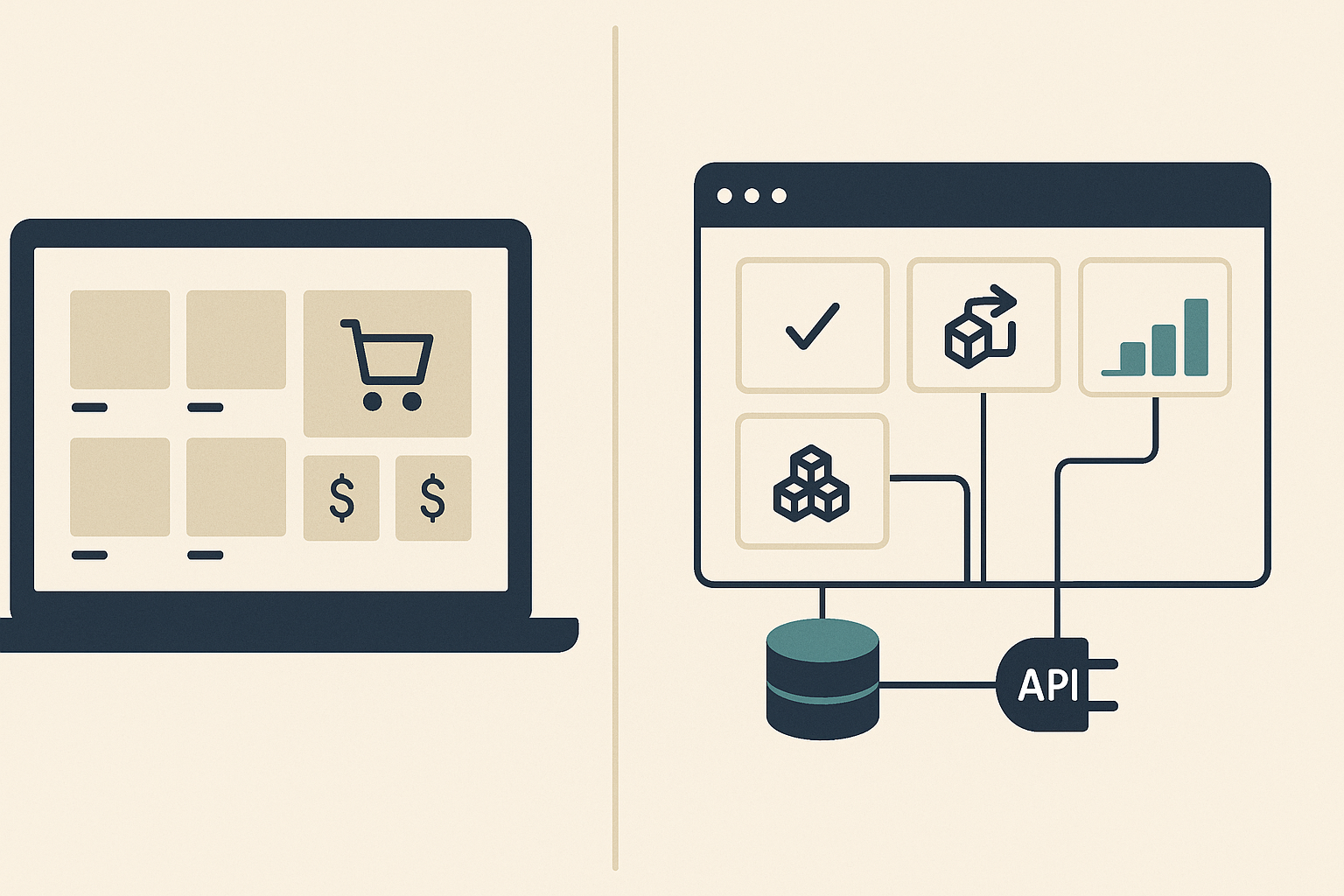
Split illustration contrasting a ready-made ecommerce storefront with a custom internal operations dashboard connected to a database and API
On this page
Quick answer (2026): For the storefront itself, an AI app builder is usually the wrong tool. A commerce platform or a dedicated AI store builder wins on catalog, checkout, payments and hosting. You reach for an AI app builder when you need custom software around the store that no off-the-shelf app covers: a supplier portal, an RMA and returns dashboard, a B2B wholesale ordering tool. For that job in 2026, the pick turns on how the app connects to your commerce backend and whether you own the code, which reshuffles the usual rankings. Lovable, Bolt.new and Replit lead for tools you plan to keep; Base44 suits a throwaway internal prototype; v0 fits Vercel shops but has stumbled on SQL-heavy data.
Most "best AI app builder for ecommerce" guides answer a question you probably are not asking. They rank storefront generators, the tools that spin up a product catalog and a checkout, and quietly file them next to code-generating app builders as if they did the same job. They do not.
AI store builder vs AI app builder: which does an ecommerce seller need?
An AI store builder generates the shopfront: product pages, cart, hosted checkout, payment, tax and shipping config, all managed for you. If your job is "sell products online," this is the category you want, and a platform like Shopify or a specialized AI store builder will get you further, faster, than any code-gen tool. Do not rebuild a catalog and checkout with a prompt.
An AI app builder generates custom software from a description. In an ecommerce context, you use it for the things a storefront and its app marketplace do not give you:
a branded supplier or vendor portal where wholesalers submit stock and see PO status
an internal returns and RMA tracker that your support team actually likes using
a B2B wholesale ordering app with account-specific pricing
an ops dashboard that stitches order, inventory and fulfillment data into one view
That is custom software wrapped around the store, and in 2026 an AI app builder lets a non-engineer stand one up in a day. Everything below is strictly about that build path. If you only need the storefront, stop here and pick a store builder.
The criteria generic ecommerce lists skip
A general "best app builder" roundup optimizes for build speed and demo polish. An ecommerce operator building a real ops tool optimizes first for two things those lists gloss over: how the app plugs into the commerce stack, and whether you own what gets built. We score the five builders on the axes that actually decide it:
Commerce and payments integration. Can it call the Shopify Admin API, Stripe and your fulfillment provider, and handle webhooks and background jobs cleanly?
Relational database. Orders, inventory and supplier records need a real relational or PostgreSQL-backed store, not a toy key-value layer.
Code ownership and export. An ops tool you depend on should not be trapped in a prototype sandbox; you want the codebase to host and extend.
Auth and roles. Staff, suppliers and customers need different access. Role-based auth is table stakes for anything touching order data.
Deploy and iteration. It must ship to a real domain, and rebuild fast enough that iterating on the tool is not painful.
The five builders scored for ecommerce custom apps (2026)
Scores below reflect fit for the custom ops-tool job described above, not storefront building. Sources: each vendor's 2026 documentation and pricing pages, plus cross-builder benchmark testing summarized on ai-agents-benchmark.com (June 2026). We cite that one unlinked and treat it as corroboration only: it names no author, discloses no affiliation with the tools it scores, and ranks Totalum first.
No single builder deserves a crown here, and any 2026 guide that hands you one is selling something. The right pick is the intersection of your commerce stack and your team's constraints.
When each one wins
Lovable is the safe default when the ops tool is data-heavy and you want the code out. Its Supabase-backed Postgres and clean export suit an orders or supplier dashboard you will keep iterating on. The honest caveat, per 2026 benchmark notes, is occasional instability on larger builds and weaker generated SEO, which does not matter for an internal tool.
Bolt.new produces the cleanest first-pass UI, so a wholesale-ordering app or a customer-facing returns portal looks presentable on day one. Watch the cost: it is known in 2026 for burning through tokens on long, iterative builds, which an evolving ops tool tends to be.
Replit is the pick when correctness beats speed. It ships real dev features and is one of the few builders with built-in auto-testing, valuable when the app touches live order data. The trade is patience: builds can be slow, so tight iteration loops are less pleasant.
v0 is the natural fit for a team already living in the Vercel and Next.js ecosystem. It is fast for interface work, but 2026 testing has flagged crashes on SQL-heavy schemas, so be cautious using it as the backend for a complex inventory model.
Base44 generates fastest and produces beautiful UIs, ideal for a quick internal prototype you want in front of the team this afternoon. The catch is lock-in: limited code portability and no npm import mean it is a poor choice for a tool you expect to own and extend for years. Prototype in it; do not build your load-bearing ops system on it.
The mistake to avoid: rebuilding checkout and PCI scope
One rule overrides every ranking above. Do not rebuild card capture or checkout inside an AI app builder. The moment your app touches raw card data, you pull yourself into PCI DSS scope, an audit burden no small ecommerce team wants. Keep payment data inside Stripe or your commerce platform, and redirect to their hosted checkout for the actual transaction. Use the builder for the workflow around the payment, the order status, the fulfillment step, the refund request, and let the payment processor own the card. This is not a limitation of any specific tool; it is the correct architecture regardless of which builder you pick.
Bottom line
For an ecommerce store in 2026, the honest answer to "which AI app builder should I use" starts with a question: are you building the storefront or the software around it? If it is the storefront, a store builder wins and an app builder is the wrong category. If it is the custom ops layer, choose on integration and ownership, not on which tool demos best. Lovable, Bolt.new and Replit lead for tools you will keep; Base44 is for the fast prototype; and whatever you choose, keep checkout in Stripe or your commerce platform. The right builder is the one that fits your existing stack and hands you code you can still change next year.
Builderdex is a criteria-based comparator for AI app builders, scoring platforms on the axes that matter for each real use case.
Frequently asked questions
Should I use an AI app builder to build my ecommerce storefront in 2026?
Usually no. For the storefront itself, a dedicated commerce platform like Shopify or a specialized AI store builder handles the catalog, checkout, payments, taxes and hosting out of the box. Reach for an AI app builder when you need custom software around the store that no off-the-shelf app covers, for example a supplier portal, an RMA and returns dashboard, or a B2B wholesale ordering tool.
What is the best AI app builder for a custom ecommerce ops tool?
There is no single winner in 2026. For a tool you plan to keep and extend, favor a builder that exports a real codebase and ships a relational database, such as Lovable, Bolt.new or Replit. Base44 is fast for a throwaway internal prototype but has vendor lock-in, and v0 has been reported to struggle with SQL-heavy data models. Pick on how the app must connect to your commerce backend and whether you need to own the code.
Can an AI app builder connect to Shopify and Stripe?
Yes, through their APIs. All five builders in this comparison can call the Shopify Admin API and Stripe from server code or via stored secrets. The differences are how cleanly each handles webhooks and background jobs, and whether the generated backend is yours to host and extend.
Is it safe to rebuild checkout with an AI app builder?
No. Never rebuild card capture or checkout yourself. Keep payment data inside Stripe or your commerce platform to stay out of PCI scope, and use the builder only for the surrounding workflow, redirecting to hosted checkout for the actual payment.
Do these builders give me PostgreSQL for orders and inventory?
Lovable, Bolt.new, Replit, v0 and Base44 all offer a relational or PostgreSQL-backed database as of 2026, which is what you want for orders, inventory and supplier records. Confirm the current tier and export options on each vendor's own pricing page before committing, since limits change.
A 6-builder scorecard for internal tools in June 2026: Totalum, Retool, Tooljet, Lovable, Bolt.new, and Base44 ranked against bundled auth, SQL connectors, RBAC, custom domains, code ownership, and per-team cost.
The best AI app builders with a real, portable PostgreSQL database in 2026, compared on database ownership and export: Lovable, Bolt.new, v0, Replit and Base44.


 Lovable
 Bolt.new
 Replit
 v0
v0 Base44