AI App Builder Real Time Data (2026): Which Ones Update the Screen Without a Reload?
Three of the eight builders we track document a real mechanism for live data in the app you ship. A scored comparison of Lovable, Bolt.new, Replit, Base44, Bubble, Softr, v0 and Webflow, with the four different things their docs mean by the phrase real time.
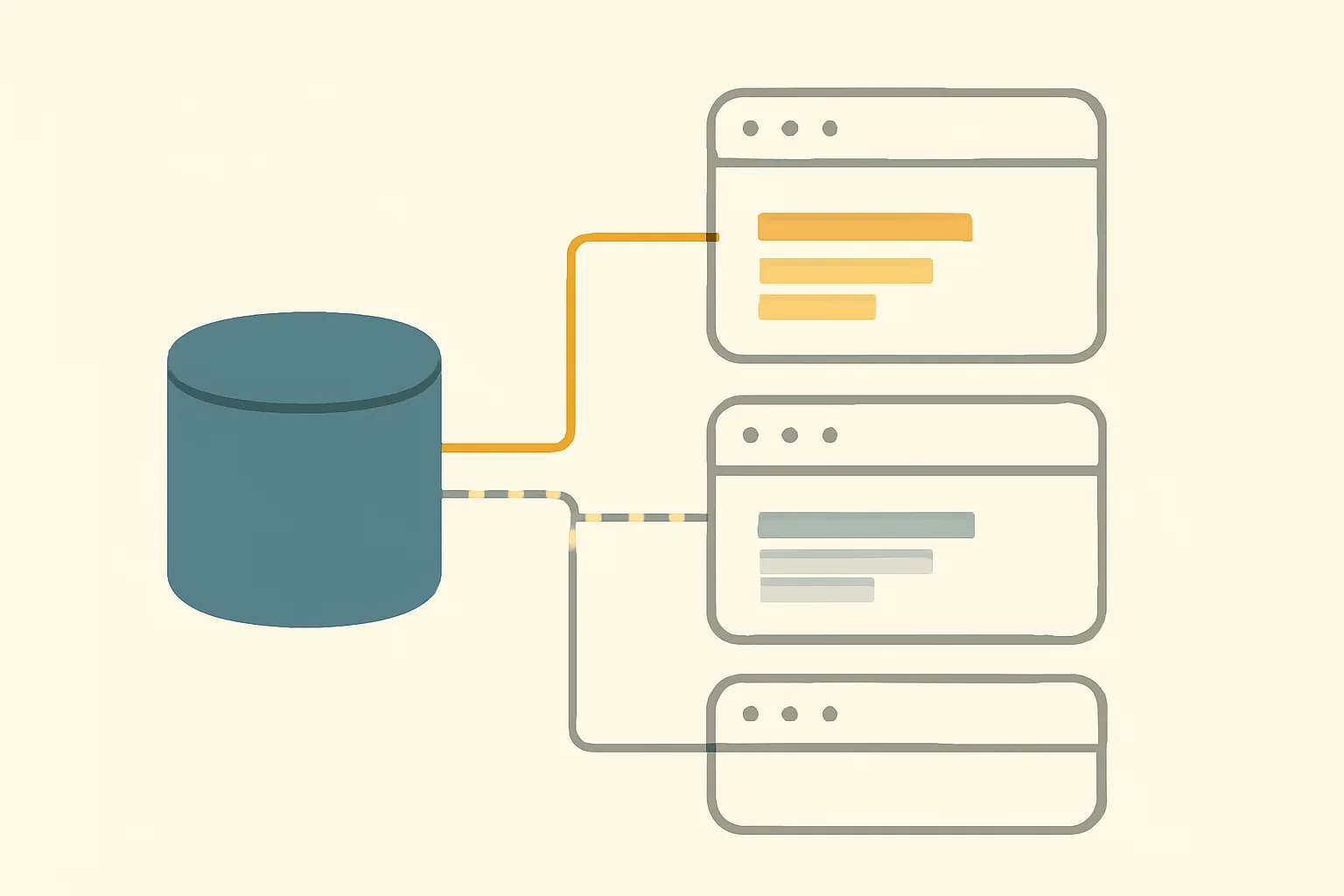
A flat minimalist illustration: a slate blue database cylinder connects by three lines to three stacked browser windows. The top has a solid amber line and amber bars, the middle a dashed grey line and grey bars, the bottom a line stopping short of an empty window.
On this page
Quick Answer
If you need the screen a user is already looking at to change when somebody else edits the data, three of the eight builders we track document a real mechanism for it in September 2026. Base44 is the most precisely specified: its SDK exposes a subscribe method that, in its own words, "establishes a WebSocket connection to receive instant updates when any record is created, updated, or deleted". Bubble is the only one where live data is the default rather than a feature you add, and it also publishes the sharpest caveat about when that default stops applying. Lovable inherits Supabase real-time subscriptions and documents that the agent will wire the subscription up when you ask for it in a prompt.
The other five are not all the same kind of no. Bolt.new has a documented two step route through Supabase. Softr documents two way sync with the data source rather than a live browser session. Replit, v0 and Webflow publish no live data primitive for the app you ship, though v0 gives you a marketplace to attach one yourself.
The word "real time" means four different things in these docs
This is the part that makes feature tables useless on this axis. We read the published documentation for all eight builders and the phrase "real time" or "live" carries at least four unrelated meanings, sometimes on the same page:
Real time collaboration in the editor. Bolt.new documents that "when your project visibility is set to public, collaborators can work together in multiplayer mode". That is two humans editing a project side by side. It says nothing about the app you ship.
"Live" as in production. Bubble's manual talks about copying data between the Development and the Live database. Replit and Bolt.new both talk about publishing to a "live" URL. That is an environment name, not a data behaviour.
Real time feedback in the builder UI. v0's documentation describes progress indicators and "live updates on each agent action" while the agent works, and separately that v0 "can search the web in real time". Again, the builder, not the output.
Live data in the shipped app. The screen a signed in user is looking at changes because a record changed, with nobody pressing refresh.
Only the fourth is the thing a buyer is asking about when they say they want a chat, a shared dashboard, a live inventory count or a collaborative board. A comparison row marked "real time: yes" can honestly mean any of the four. This page only scores the fourth.
Axis 1: is there a live data primitive at all
The two builders that name the transport.
Base44 publishes the clearest specification of the eight. Its entity SDK exposes a subscribe method documented as subscribing "to realtime updates for all records of this entity type", establishing a WebSocket connection, and returning an unsubscribe function to clean up. The callback receives an event carrying the record id, the event type, the record data and an ISO 8601 timestamp of when the event occurred. It is the only one of the eight whose own API reference names WebSocket explicitly.
Lovable does not run its own real time layer. It connects to Supabase, and Supabase supplies it. The documentation is direct about what that buys: "Supabase can stream database changes to your app, which enables features like live chat, notifications, or dashboards that update for all users without refreshing", and it lists "live chat, feeds, and dashboards using Supabase's real time subscriptions" as a reason to connect. The notable detail is the authoring model rather than the plumbing: Lovable documents that you prompt for the behaviour and the agent wires the subscription, giving a worked prompt of the shape "make the chat update in real time so new messages appear without refreshing".
The one where it is the default.
Bubble is the odd one out, and in the buyer's favour. There is no subscription to set up because element level searches are already live. The manual states that element data sources using a search "stay synced with the database in real time", and that "any change in the database, even one made by another user, shows up in your app right away, with no need to manually refresh the search". Nothing about that sentence is opt in.
The one with a route rather than a feature.
Bolt.new documents no live data primitive of its own. What it documents is an exit: a Bolt database can be claimed in Supabase, and the stated reason to do it is "to access advanced Supabase features". Once the database is a Supabase project, Supabase real time is available on the same terms it is available to anyone else. That is a real answer, and it is two steps rather than one, with a precondition covered in axis 2.
The four with no documented primitive.
Softr documents sync, which is a different axis. Its data source documentation promises "2-way sync: instantly sync changes between your data source and your Softr app without republishing", and its setup walkthrough asks you to change a record in the source and "verify that the update is reflected in real-time within your app". Read carefully, that describes the app reflecting the current state of the source without a republish step. It does not describe an open browser session mutating while nobody touches it, and we found no documentation of the latter.
Replit publishes a use case recipe for a dashboard that "refreshes automatically", expressed as a prompt you give the agent. That is a polling pattern you are asking the model to build, not a platform capability the docs commit to. We found no real time or WebSocket primitive in the Replit documentation we read.
v0 is a code generator sitting on the Vercel ecosystem, and its answer is the marketplace: it documents installing and managing integrations including Supabase, Neon and Upstash. So real time is reachable, but as something you attach and wire yourself, exactly as you would in any Next.js project. v0 itself commits to nothing on this axis.
Webflow is the clearest absence. Across its developer documentation index we found zero occurrences of real time, WebSocket, live data or subscribe. Its Data API is a REST surface for reading and writing CMS content.
Axis 2: what has to be true before it fires
A primitive existing and a primitive being available to you are different questions, and three of the builders attach a condition that no feature table carries.
Bolt.new: you must be a Supabase organisation owner. The claim flow is explicit that "to claim your database in Supabase, you must be a Supabase org owner", and that "these permissions are controlled through your Supabase account, not through Bolt". If you are a developer on someone else's Supabase org, the route to real time is a request to another person, not a button in Bolt. Bolt's docs also warn that connecting a different Supabase database to a project that already has a Bolt database "will replace the connection, which may cause data loss", and point at claiming as the way to keep your data.
Lovable: your row level security has to be right, because it governs real time too. Lovable's database documentation states that row level security "controls which data users can access across your database, storage, and realtime features". A stream of database changes is a new way for a badly scoped policy to leak rows, because the client is now receiving events rather than only the rows it asked for. Lovable also exposes a Realtime filter in its logs, which is the surface you would use to check what is actually being emitted.
Bubble: auto binding is web only. Bubble's writes have two modes, workflows and auto binding, where auto binding "sends updated information to the server immediately when a field is edited". The manual carries an explicit note that "auto-binding is only available in web apps", so the instant write half of the story is not available in a Bubble native mobile build.
Axis 3: the documented exception nobody carries forward
Bubble publishes the single most useful sentence on this page, and it is a caveat rather than a capability. Immediately after stating that element searches stay synced in real time, the manual adds: "the exception is a search that was initially fetched in a workflow."
That is worth slowing down on, because it is the failure mode that will actually reach your users. Two screens in the same app can look identical, display the same records, and behave differently: the one whose list came from an element level search updates by itself, and the one whose list was fetched inside a workflow does not. Nothing on the page tells the user which they are looking at, and nothing in a feature comparison would ever surface it. If you are building on Bubble and a list is mysteriously stale, this is the first thing to check.
Where the eight builders land, September 2026
Scroll to see more
Builder
Live data in the shipped app
Documented mechanism
Condition attached
Base44
Yes
SDK subscribe method over a WebSocket, create, update and delete events
None documented
Bubble
Yes, by default
Element level searches stay synced with the database
Exception for searches fetched in a workflow; auto binding is web only
Lovable
Yes, via Supabase
Supabase real time subscriptions, wired by the agent from a prompt
Row level security governs realtime as well as reads
Bolt.new
Route, not a feature
Claim the Bolt database in Supabase, then use Supabase real time
Requires Supabase organisation owner permissions
Softr
Sync, not live sessions
Two way sync with the connected data source without republishing
No documented live update of an open session
v0
Bring your own
Attach Supabase, Neon or Upstash from the Vercel Marketplace
You wire and maintain it yourself
Replit
Not documented
A prompt recipe for a dashboard that refreshes automatically
Polling you ask the agent to build
Webflow
Not documented
REST Data API for CMS content
Zero real time references in the developer docs
Every "not documented" cell above is a statement about the published documentation we read in September 2026, not a claim that the product cannot do it.
The details that decide whether it works
Ask what happens to the connection, not just whether there is one. Base44 is the only one of the eight that documents the cleanup half, returning an unsubscribe function specifically to close the connection. On a screen a user opens and closes fifty times, that is the difference between a stable app and one that leaks connections.
A stream is a permissions surface. The Lovable case generalises. The moment your app receives events instead of only responses to its own queries, every row that crosses the wire is a row your policy allowed. If you have ever tested authorisation by checking which pages render, that test no longer covers you.
Polling is a legitimate answer and it is not the same answer. Replit's automatic refresh recipe will genuinely keep a metrics dashboard current, and for a dashboard that is usually fine. It is not fine for a chat, a seat picker, a bidding screen or anything where two users can collide inside the polling interval. Decide which you are building before you decide the builder matters.
Do not confuse this with the outbound direction. Live data is about your own users' screens. Telling another system that something changed is a different mechanism with a different per builder answer, which we cover in our guide to webhooks across AI app builders. Reaching a device that has your app closed is a third mechanism again, covered in push notifications across AI app builders. A single product can be strong at one and publish nothing about the other two.
Verdict, September 2026
If live data is a requirement rather than a nice to have, Base44 and Bubble are the two that answer without qualification, for opposite reasons. Base44 gives a developer an explicit, documented subscription API with a named transport and a cleanup path. Bubble gives a non developer the behaviour for free and asks them to remember one exception.
Lovable is the strongest option if you want real time without writing the subscription yourself, because the capability is Supabase grade and the authoring step is a prompt. Budget the row level security work rather than assuming it.
Bolt.new is viable if you already own the Supabase organisation. If you do not, treat it as blocked until somebody grants that.
Softr, Replit, v0 and Webflow are the wrong starting point for a genuinely live product in September 2026. v0 is the most recoverable of the four, because attaching Supabase is a normal thing to do in a Next.js codebase and the marketplace path is documented.
Limitations
We scored published first party documentation, not running applications. We did not build a test app on each platform and measure whether an open session actually mutated, and we did not measure latency, reconnection behaviour after a dropped network, or how many concurrent subscriptions each platform tolerates. Several products expose capabilities that are real but undocumented, and a documentation absence is the weakest kind of evidence: it is the correct thing to report and it is not proof of a missing feature. The Bubble exception and the Bolt.new ownership precondition are quoted from the vendors' own pages and are the two findings here we would most expect a hands on test to confirm.
The Builderdex editorial desk builds structured, criteria-based comparisons of AI app builders. We test every claim against primary vendor documentation and date every figure.
Frequently asked questions
Which AI app builders support real time data in 2026?
Base44, Bubble and Lovable document a real mechanism for updating a live session. Base44 exposes an SDK subscribe method over a WebSocket, Bubble keeps element level searches synced with the database by default, and Lovable inherits Supabase real time subscriptions. Bolt.new has a documented route through claiming its database in Supabase. Softr, Replit, v0 and Webflow publish no live data primitive for the app you ship, though v0 lets you attach Supabase, Neon or Upstash from the Vercel Marketplace.
Does Bubble update data in real time automatically?
Yes, with one documented exception. Bubble's manual states that element data sources using a search stay synced with the database in real time, and that a change made by another user shows up right away with no need to refresh. The manual then adds that the exception is a search that was initially fetched in a workflow. Those searches do not stay live, which is the most common cause of a stale looking list in a Bubble app.
What is the difference between real time data and webhooks?
Real time data is inbound to your own users: the screen somebody has open changes because a record changed. A webhook is outbound to another system: your app tells a third party that something happened. They are different mechanisms with different per builder answers, and a product can be strong at one while publishing nothing about the other.
Does Lovable need Supabase for real time updates?
Yes. Lovable does not document a real time layer of its own; it connects to Supabase and Supabase supplies the subscriptions. Lovable's documentation says Supabase can stream database changes to your app for features like live chat, notifications and dashboards that update without refreshing, and that you can prompt Lovable to make a feature update in real time and it wires up the subscription.
Can Bolt.new do real time updates?
Not with a primitive of its own. Bolt.new documents claiming your Bolt database in Supabase in order to access advanced Supabase features, after which Supabase real time is available normally. The condition that matters is permissions: Bolt's documentation states you must be a Supabase organisation owner to claim the database, and that those permissions are controlled through your Supabase account rather than through Bolt.
Is a dashboard that refreshes automatically the same as real time?
No. Replit's documented pattern is a prompt recipe for a dashboard that refreshes automatically, which is polling the agent builds for you rather than a platform capability. Polling is usually fine for a metrics dashboard and is not fine for chat, seat selection, bidding or anything where two users can collide inside the refresh interval.
Does real time data affect security in an AI app builder?
It widens the surface. Lovable's documentation notes that row level security controls which data users can access across the database, storage and realtime features. Once a client receives a stream of change events rather than only responses to its own queries, every row crossing the connection is a row your policy permitted, so testing authorisation by checking which pages render no longer covers you.
Every AI app builder can send an HTTP request out. Far fewer let something on the internet call your app at a URL you control. Eight builders compared on inbound endpoints, plan gates, idle behaviour and signature verification.
Push is three jobs, not one: get a device token, store it against a user, and send. Eight AI app builders compared on the middle job, the one that decides whether a notification ever arrives, from primary vendor documentation.
Every AI app builder can run code. Far fewer can run it on a clock that survives your browser closing. Eight builders compared on whether background work runs unattended, where the schedule is actually stored, and whose permissions it runs under.